We Read the Breathing Book Everyone Keeps Recommending. Here Is What Actually Stuck.
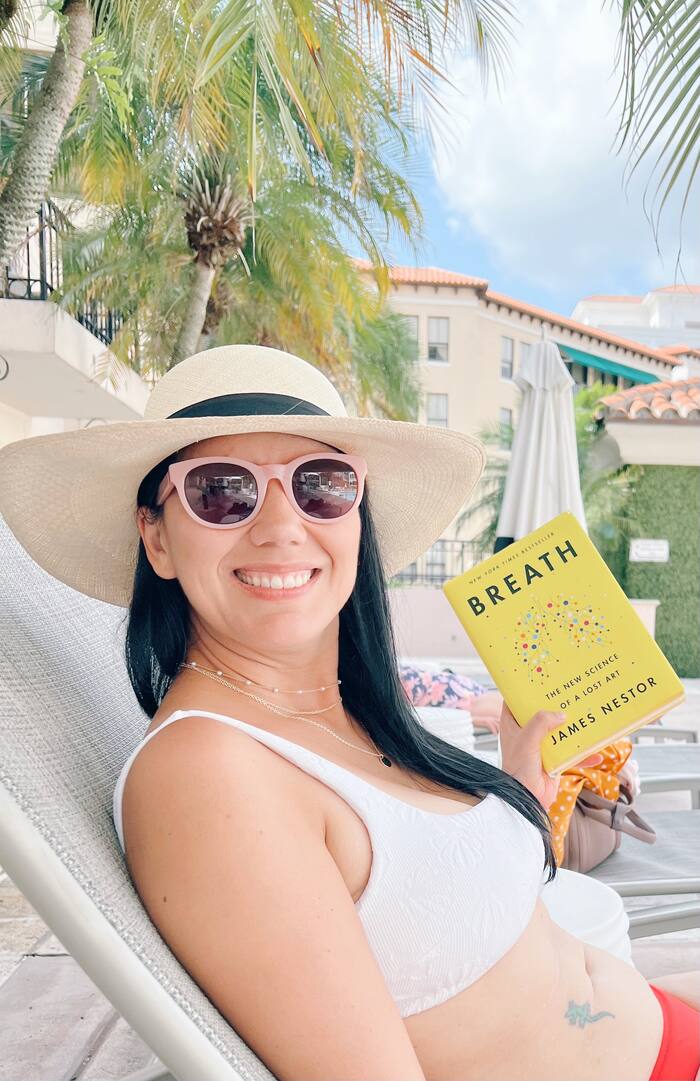
Everyone has that friend. The calm one. The one who says have you read Breath in the middle of a conversation about parking. I am that friend now, and I am sorry, and I was right.
Here is the deal: James Nestor’s Breath is a whole book about something you have been doing badly, for free, since birth. I spent a month with it by the pool, tried the exercises so you do not have to guess which ones are worth your time, and by week two exactly three of them had earned a permanent spot. These are those three.
1. Close your mouth. That is the whole first one.
Nestor’s big claim is that most of us are chronic mouth breathers, and that nasal breathing filters, warms, and slows the air in ways your body actually wants. He tested it on himself by taping his mouth shut for ten days. I did not tape my mouth shut, because I have a life and a partner who deserves better.
What I did do: set a reminder that just said “nose?” three times a day. Every single time it went off, my mouth was open. Every time. After about a week I stopped needing the reminder, and the thing I noticed first was not calm, it was that I stopped waking up with a dry throat.
2. The 5.5 rule, which is the one I use before meetings
Breathe in for about five and a half seconds. Out for about five and a half seconds. That works out to a little more than five breaths a minute, which is dramatically slower than most of us breathe when we are, say, waiting for someone to join a Zoom.
You do not need to count precisely. I do a slow in through the nose, a slow out through the nose, and I aim for five rounds. That is roughly a minute. It is genuinely less time than making a cafecito, and it is the single thing on this list I have used the most, because it is the only one that works in public with nobody noticing.
3. The longer exhale, for when your body has already decided to panic
When you are past the point of gentle, the move is to make the exhale longer than the inhale. In for four, out for six or eight. The physiology is real — a long exhale nudges the parasympathetic system, the one in charge of “we are fine” — but the part I want you to hear is that it works when you are already spiraling, which is more than I can say for most advice.
What did not stick
The elaborate stuff. Tummo, the breath-hold work, the whole protocols with names. Not because they are bad, but because they require a floor, a quiet room, and twenty minutes, and if a habit needs a floor and a quiet room I am not going to do it in August in Miami.
That is the honest summary of every wellness book, by the way: the value is in the two or three things small enough to survive a normal Tuesday. Take those. Skip the protocol. Nobody is grading you.
One more thing, because I have to say it: this is a magazine, not a clinic. If your breathing is genuinely difficult, that is a doctor conversation, not a book conversation.